
react-i18next vs. Lovalingo: The Hidden Costs Nobody Talks About
Discover the hidden costs of using react-i18next for internationalization compared to solutions like Lovalingo. This post exposes the manual effort and SEO challenges that often go unmentioned, turning quick setups into time-consuming projects. Learn why traditional i18n approaches break the promise of rapid development.
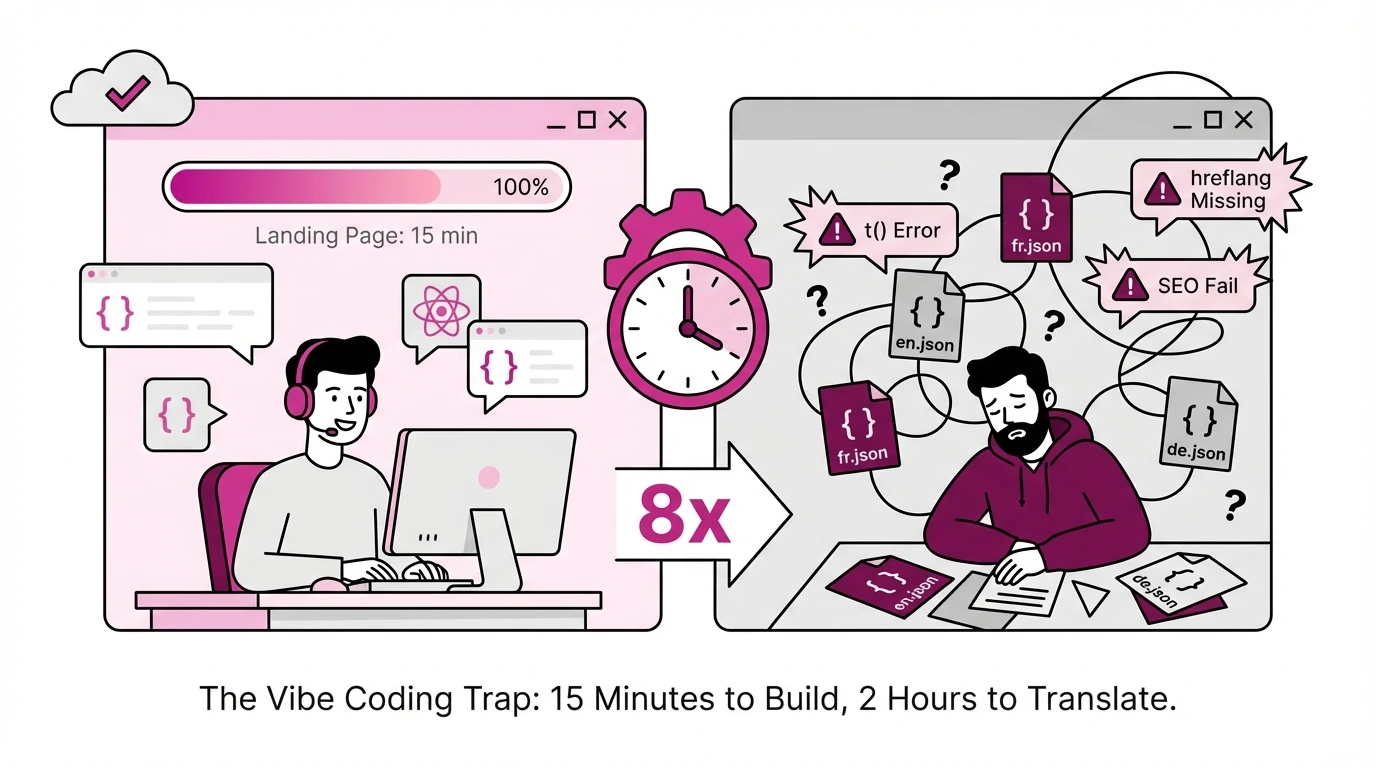
I generated my landing page in 15 minutes with Lovable.
Then I spent 2 hours adding translations manually.
That's an 8x multiplier in the wrong direction. And I still didn't have proper SEO. No translated meta descriptions. No hreflang tags. No multilingual sitemap.
When I stepped back and looked at what I was doing, one question kept coming back: Why is this so complicated in 2026?
The Vibe Coding Promise, Broken
The whole point of tools like Lovable, Bolt, and Cursor is speed. You describe what you want. AI generates it. You iterate in natural language. Ship in hours, not weeks.
Then you try to add French and German support.
Suddenly you're back in 2015. Manually wrapping every string in t() functions. Creating JSON files for each language. Configuring namespaces. Debugging hydration mismatches.
The 15 minutes of creative flow? Gone. Replaced by 2 hours of translation plumbing.
This isn't a edge case. This is the standard experience. And it's broken.

What ChatGPT Tells You vs. What Actually Happens
Ask ChatGPT how to internationalize a React app. It will say: "Use react-i18next. Here's how to get started."
The Get Started guide looks simple:
Install the package
Create a config file
Wrap strings with
t()Add JSON translation files
It works. In the tutorial. With 3 strings. In one language.
What the tutorial doesn't show:
A real app has 50-100 translatable strings per page. That's 50-100 manual wrappings. Then 50-100 keys to add in en.json. Then copy-paste to fr.json, de.json, it.json.
Now change one button label. Open 4 files. Find the right key. Update each one. Hope you didn't miss any.
This is what "simple" looks like at scale.
The SEO Disaster Nobody Mentions
Here's what react-i18next does NOT do automatically:
Translated meta descriptions? No. You code that manually.
Hreflang tags? No. You code that manually.
Multilingual sitemap? No. You code that manually.
Language-specific URLs? No. You configure that manually.
HTML lang attribute? No. You set that manually.
The react-i18next documentation focuses on translating visible text. But SEO is where international traffic actually comes from. And it's 100% on you to implement.
Most developers discover this after launch. Their French pages exist but Google doesn't know they're French. No hreflang means no proper indexing. No translated meta means poor click-through rates.
The "Get Started" guide got them started. It didn't get them found.
The 99% Content Waste Problem
Research from Intlayer revealed something worse:
"Nearly half of the projects using i18next don't manage their content in namespaces or load all namespaces on every request."
What does this mean in practice?
If you have 10 pages in 10 languages, and you're loading all namespaces on every request, your users download content for 100 page variants just to view one page.
That's 99% of loaded content that is never accessed.
Your French user loading your homepage? They're also downloading the German, Italian, Spanish, Portuguese, Dutch, Polish, Swedish, and Japanese versions of every page. In the background. Slowing everything down.
This happens because namespace configuration is complex. Tutorials skip it. ChatGPT doesn't emphasize it. Developers don't know it's a problem until their Lighthouse scores tank.
The JSON File Multiplication Nightmare
Let's do the math for a modest multilingual site:
5 pages
4 languages (English, French, German, Italian)
2 namespaces per page (common, page-specific)
That's 8 JSON files minimum. More realistically, 12-16 files as your app grows.
The sync problem:
Monday: You change the CTA from "Get Started" to "Start Free Trial"
What you have to do:
Find the key in
en/common.jsonUpdate the English value
Open
fr/common.json, update or mark for translationOpen
de/common.json, update or mark for translationOpen
it/common.json, update or mark for translationCommit all files
Hope your translator sees the change
Merge their updates later without conflicts
What you wanted to do:
Change the button text
This multiplication happens for every text change. Every new feature. Every A/B test variation.
At some point - and it happens faster than you think - this becomes ingérable.
What Lovalingo Does in 2 Prompts
I rebuilt the same workflow with Lovalingo. Here's what it actually looks like:
Prompt 1: Installation
Go to lovalingo.com, paste your site URL, select your languages (French, German, Italian), copy the installation prompt, paste it in Lovable, run it.
Time: minutes.
Your site now has:
Automatic string detection
Language switcher
Translations generating in background
Prompt 2: SEO Setup
Copy the SEO prompt from Lovalingo dashboard, paste it in Lovable, run it. Add one line to package.json for the sitemap script.
Time: 3 minutes.
Your site now has:
Translated meta descriptions
Proper hreflang tags
Multilingual sitemap
Ready for Google Search Console
Total time: 8 minutes.
Not 2 hours. Not ongoing JSON file management. Not manual SEO implementation.
8 minutes, then it works. You go back to building your product.
The Phone Network Analogy
Using react-i18next in 2026 is like wanting to call someone abroad, but first having to learn how to build the telephone network.
You don't want to understand namespace configuration. You don't want to manage JSON file synchronization. You don't want to manually implement hreflang tags.
You want your French visitors to see French. Your German visitors to see German. Google to index both correctly.
That's it. That's the entire requirement.
Everything else is plumbing. And in 2026, plumbing should be invisible.
When you send an email, you don't configure SMTP servers. When you accept payments, you don't build payment rails. When you want translation, you shouldn't build translation infrastructure.
You should describe what you want and have it work.
Side-by-Side Comparison
Time Investment
Task | react-i18next | Lovalingo |
|---|---|---|
Initial setup | 2-4 hours | minutes |
SEO implementation | 2-4 hours | 3 minutes |
Per-page string wrapping | 15-30 min | 0 min |
Adding new language | 1-2 hours | 2 minutes |
Ongoing JSON maintenance | Weekly | None |
First year total | 40-80 hours | Under 1 hour |
SEO Coverage
Element | react-i18next | Lovalingo |
|---|---|---|
Translated meta titles | Manual | Automatic |
Translated meta descriptions | Manual | Automatic |
Hreflang tags | Manual | Automatic |
Multilingual sitemap | Manual | Automatic |
HTML lang attribute | Manual | Automatic |
Language-specific URLs | Manual config | Automatic |
Maintenance Burden
Scenario | react-i18next | Lovalingo |
|---|---|---|
Change one button label | Edit 4+ JSON files | Change the text |
Add new page | Create keys, wrap strings, update all JSONs | Add the page |
Fix typo | Find key, update all language files | Fix the typo |
Remove feature | Delete keys from all files, remove t() wrappers | Delete the feature |
Vibe Coding Compatibility
Workflow | react-i18next | Lovalingo |
|---|---|---|
AI generates component | Must manually add t() wrappers after | Works automatically |
Natural language iteration | Breaks when i18n added | Continues working |
Quick prototyping | Blocked by translation setup | Unaffected |
Ship same day | Unlikely with i18n | Yes |
When react-i18next Still Makes Sense
To be fair, react-i18next is powerful software. It makes sense when:
You have a dedicated frontend team with i18n experience
You need complex pluralization rules for specific languages
You have an existing TMS workflow with Lokalise or Crowdin
You're building a large enterprise app with strict localization requirements
You have weeks, not hours, to implement properly
For these cases, react-i18next's flexibility is valuable.
But if you're a founder using vibe coding tools to move fast? If you want multilingual support without becoming a translation infrastructure expert? If you need SEO to work without manual implementation?
react-i18next will slow you down. Not because it's bad software. Because it's software designed for a different workflow.
The Bottom Line
I didn't want to spend 2 hours translating a 15-minute landing page.
I didn't want to manually implement hreflang tags.
I didn't want to manage JSON files across 4 languages.
I didn't want to debug hydration mismatches.
I wanted my French visitors to see French, my German visitors to see German, and Google to index both correctly.
That's not a complex requirement. In 2026, it shouldn't require complex infrastructure.
The question isn't "which library has more features."
The question is: "Do you want to build telephone networks, or do you want to make calls?"
Lovalingo lets you make calls.
Ready to stop managing JSON files? Set up Lovalingo in 8 minutes at lovalingo.com