
Limitation of Vibe-coded applications.
Vibe-coded applications, while offering rapid development, often lack architectural design, security, and scalability planning. This can lead to significant technical debt and overlooked critical aspects like Multilingual offering, SEO and internationalization, hindering long-term growth and evolution.

With over two decades dedicated to software development, I harbor a deep appreciation for vibe coded solutions.
However, as I delve further into their intricacies, an unsettling familiarity emerges – they often echo the constraints and challenges we painstakingly resolved through the adoption of standardized software development practices.
A primary concern is the prevalent lack of architectural design and rigor security within many vibe-coded environments; solutions are frequently assembled haphazardly, lacking foundational design principles. While scalability is indeed achievable, reaching and sustaining robust levels of performance necessitates a multi-faceted approach, incorporating dedicated planning agents and a meticulously configured infrastructure designed explicitly to support growth.
Vibe Coded Technical Debt
Crucially, the temptation to construct monolithic vibe-coded applications must be resisted, as these inevitably lead to bottlenecks and technical debt.This brings us to a fundamental question: what does it truly mean to be a software developer in an era where AI can effortlessly stitch together code snippets? The role extends far beyond mere assembly. There are considerable practical limitations when deploying comprehensive tooling built purely with current vibe-code and AI-driven platforms like V0, Lovable, and similar offerings. Critical aspects such as internationalization (translation), search engine optimization (SEO), optimizing page load speed, ensuring reliable hosting, and adhering to complex regulations like cookie consent often receive insufficient attention.
These, along with countless other potential risks and limitations, are frequently overlooked when projects are hastily cobbled together. For the initial objective of rapidly delivering a minimum viable product to users, this agile, low-overhead approach can indeed be acceptable.
Yet, when the aspiration shifts to scaling, refining, or substantially evolving the application, a vibe-code solution without a well-defined underlying structure quickly becomes an impediment.
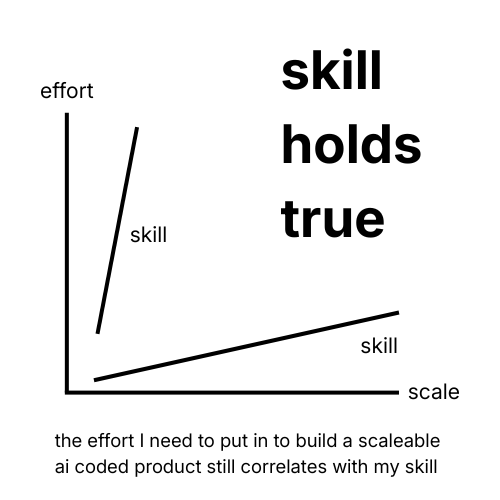
Conversely, when augmented by proper structural planning and a profound understanding of software engineering principles, vibe-code can become a powerful accelerator for development cycles. The intrinsic limitations of vibe-code applications are, in essence, a reflection of the expertise possessed by the individual wielding these tools.
The limit of vibe coded products
Let me elaborate with a more comprehensive practical example. When it pertains to the intricate domain of translation, for instance, a variety of sophisticated tools exist, such as i18n frameworks. The endeavor of not merely implementing i18n but also meticulously configuring your entire project so that it operates with optimal efficiency and genuinely scales effectively with the demands of translation presents a significant hurdle where Large Language Models (LLMs) demonstrably encounter profound difficulties. The fundamental nature and inherent characteristics of an LLM dictate that if you input a substantial block of text, perhaps a thousand words, the probability of reliably retrieving precisely the same thousand words, verbatim and consistent, after merely ten iterative cycles of processing is, for all intents and purposes, virtually nonexistent > they go against 0. There is a vast body of academic literature and numerous research papers that delve into this precise limitation.
Consequently, if one conceives of translation as an inherently deterministic and rigorously repeatable task, it becomes imperative to thoughtfully consider and fundamentally understand the underlying algorithm and structural mechanics that govern such a process. While it is certainly possible to pose queries about these topics to an LLM, the true acquisition of knowledge and a deep understanding of these principles demands considerable skill and expertise. Should an individual entirely lack this acquired skill, their approach will likely be simplistic, merely stating, “I just want to translate it.” This rudimentary method might indeed appear to function adequately for an initial, small-scale task, perhaps a single page comprising just a hundred words. However, its inherent limitations will become painfully evident and utterly insufficient at scale, when faced with the demanding requirement to translate upwards of thirty, fifty, or even hundreds of pages.
The architectural decisions, born from a lack of necessary skill and foresight, will inevitably come back to haunt the development process and impede any attempts at successful scaling with vobe coding. This critical distinction is often overlooked, leading many people to erroneously assert that “vibe-coded products inherently don’t scale.” This assertion is not necessarily accurate; in reality, there is no intrinsic scaling limit imposed by the vobe-code products themselves. Rather, the definitive limit emerges when these powerful tools are wielded by a builder who fundamentally lacks the requisite skills and deep understanding of the underlying principles.
Is there a limit with vibe-coding?
Yes the knowledge of the user. The more profound one’s programming knowledge and architectural acumen, the more effectively and rapidly they can leverage vibe-code platforms and multi agents to their full potential. Therefore, for those entering this space without a strong technical background, it becomes absolutely paramount to acquire comprehensive education in programming fundamentals and the critical art of architectural decision-making, ensuring that these powerful tools are employed intelligently and sustainably.